Black Pioneers
Celebrating Black Pioneers of Women’s Football, part 3.
This is part three of Clare McEwen’s mini series celebrating the Black women of women’s football history for Black History Month.
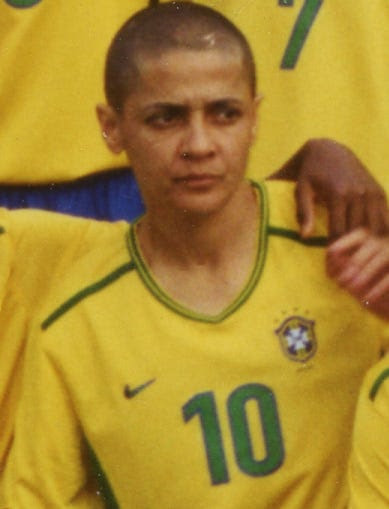
Sissi
Sissi – Sisleide do Amor Lima – was born in a small town in Brazil in 1967. She began playing with her older brother and father when she was around seven years old – at a time when women were banned from playing football in the country.
And this wasn’t a ban on using pitches, like it was in England and other countries across the world. Brazil actually made it illegal for women to play football between 1941 and 1979. Being caught playing meant being detained by the police – even if you were a child.
Being told it was a game for boys wasn’t acceptable to Sissi – her rebellious nature meant she continued undeterred.
Anything and everything served as a ball for Sissi – oranges, balled up socks, even the heads of her dolls (I’d have felt the same Sissi!).
At age 14, she left home to follow her dream in Salvador, Brazil.
In 1988, she became part of the Brazil ‘national’ team that built the platform for Marta’s generation. Sissi was part of the club team EC Radar who represented Brazil in the Fifa World Cup test event in China.
At the inaugural women’s football event at the 1996 Olympics she scored against Germany and the team finished in fourth – a really strong showing after the 1995 World Cup where they finished bottom of their group (albeit on goal difference).
It was the 1999 Fifa World Cup that brought the attacking midfielder’s name to the world.
Brazil had an excellent tournament, finishing top of their group – a group that also had Germany, Italy, and Mexico in it.
Sissi scored seven goals across the competition – sharing the Golden Boot with Sun Wen.
None were more important than the one against Nigeria in the quarter-final.
The game had been a dramatic one, although it didn’t start that way. After 35 minutes, Brazil were 3-0 up and cruising to the semi-final. But whatever was said in Nigeria’s half-time talk did the trick and by the 85th minute, they were level.
The game went to Golden Goal extra time.
In the 105th minute, Brazil won a free kick just outside the box. Sissi stepped up, took a breath, and scored an absolute worldie into the top left corner, squeezing it past the goalkeeper’s outstretched hand.
It was the first Golden Goal in women’s football.
And it changed Sissi’s life.
Brazil lost out to the US in the semi-final but had officially stamped their mark on the international game.
But it turned out to be Sissi’s last World Cup. She didn’t play for her country again after 2000.
Sissi continued to play her club football in Brazil for the next couple of years before signing for Bay Area CyberRays (later San Jose CyberRays) in 2001 to play in the US’ first professional league.
She continued to play in the US after the league folded and in 2009 signed for FC Gold Pride as their assistant coach.
It turned out she wasn’t quite ready to give up playing and made three appearances for the team, making her the oldest player in the league at 42.
Sissi was inducted into the International Football Hall of Fame in Pachuca, Mexico in 2019 (alongside some big names in men’s football, Gabriel Batistuta and Didier Deschamps for example) and she continues to coach youth football in the US.

Briana Scurry
Briana Scurry’s legend was probably secured the second she saved Liu Ying’s penalty kick in the 1999 World Cup final.
On home soil, in front of 90,000 people, USA’s Brandi Chastain scored her famous penalty to beat China. But it was Scurry’s controversial save that set her up.
Briana was born in Minneapolis, Minnesota in 1971. A natural athlete, she won a range of sporting accolades at school before going to the University of Massachusetts.
During her university career, she kept 37 clean sheets in 65 starts.
Briana finished her college career in 1993 and began her international career a year later.
Her first cap was against Portugal in March 1994, where she kept a clean sheet.
She became the US number one in her first World Cup in Sweden 1995.
Controversially, she was sent off in the second game having been judged to have handled the ball outside the box while kicking from her hands. A straight red seemed harsh. [Mia Hamm took the gloves and made two saves in the eight minutes of time left].
Briana played every minute of the historic first Olympic women’s football tournament in Atlanta 1996. The US team won gold.
This wasn’t just a historic event for women’s football, the Olympic movement, and the US team. It was the completion of Briana Scurry’s dream.
Having watched the US ice hockey team beat the Soviet Union at the 1980 Winter Olympics, eight year old Briana decided she wanted to be an Olympian. As a teenager, she refined the goal to compete in the 1996 Summer Olympics.
She wrote on a piece of paper “Olympics 1996. I have a dream” and stuck it on her bedroom wall. It was the first and last thing she saw each day.
Dream achieved at Atlanta.
In 1999, she conceded only three goals in the World Cup, keeping four clean sheets, including a wonderful performance against Brazil in the semi-final.
Briana Scurry had the tournament of her life, culminating in that penalty save that opened the door to victory. But it remains a controversial save. When Liu Ying struck her spot kick, Scurry was already several feet off her line. Briana later admitted it.
In her defence, it seemed a regular occurrence at this point in history – everyone was doing it. Briana later said she was testing what the referee would do if she came off the line too early. Her tests showed that the ref wouldn’t spot it, so she continued to do it. She wouldn’t get away with it now.
Having been dropped from the number one spot for the 2000 Sydney Olympics (although she was in the squad), Briana won her place back after strong performances with her club Atlanta Beat.
She was one of the founding players of the world’s first professional women’s league, Women’s United Soccer Association (WUSA).
She continued to be the first choice for the 2003 World Cup and the 2004 Olympics.
Briana Scurry played 175 times for her country between 1994 and 2008 – a stellar career. But there was one more opportunity for controversy.
Reaching the end of her career, Scurry had been sidelined for Hope Solo in 2005. During the 2007 World Cup, Solo was first choice goalkeeper until the semi-final. And then US manager Greg Ryan picked Scurry ahead of her.
He said it was because Scurry had an exceptional record against their opponents Brazil – she had a 12-0 record with eight clean sheets.
Hope Solo was not impressed.
And she may have had a point. The game was not the USWNT’s finest and they ended up losing 4-0.
Briana continued as one of the US team’s goalkeepers until Pia Sundhage dropped her in 2008.
Briana Scurry became the first African-American woman to enter the US National Soccer Hall of Fame.

Perpetua Nkwocha
It was often tough for girls to play football in Africa. Perpetua told Vanguard in 2014 that her father forbade her from playing and beat her to try to discourage her.
But it didn’t quell her passion and it didn’t stop her playing out in the street with the boys. It also didn’t stop her from getting to the top of the game.
Born in Imo State in 1976, Perpetua Nkwocha went on to captain the Super Falcons and redefine football for women in her country.
She began playing organised games at her secondary school, and when the school represented her local area in a competition, Perpetua was selected to play.
She was later scouted by clubs in the area and played for Rivers Angels and Pelican Stars in the Nigerian league.
She made her debut for Nigeria in 1999 and played her first major tournament at the Sydney Olympics in 2000 – where she scored against China.
Her strength and skill in midfield soon became an integral part of the Super Falcons. As did her goals.
She scored 80 goals across 99 games, won five African Women’s Championships and played in four Fifa Women’s World Cups between 2003 and 2015.
Her defining moment came in 2004 at the African Women’s Championship in South Africa (now known as the Women’s Africa Cup of Nations, WAFCON). She scored a record nine goals across the tournament, including four goals in Nigeria’s 5-0 demolition of Cameroon in the final, in Johannesburg.
Perpetua won the CAF African Women’s Footballer of the Year in 2004, 2005, 2010, and 2011.
In 2007, she moved to Sweden to play her football, joining Sunnanå SK. She described her move to Sweden as a “huge turning point” because she began to earn enough to give her financial independence – and to help support her family back in Nigeria.
She spent nine seasons at Sunnanå and made her last World Cup appearance at Canada 2015 when she was 39 years old.
She became a player-coach at a lower league Swedish club and spent time coaching teenage Afghan refugees in Sweden. In 2016, she was appointed assistant coach of the Super Falcons and the team went on to win the 2016 WAFCON in Cameroon.
Highlights:
Semi-final 1999 USA v Brazil:

Final penalty shootout 1999 USA v China:

Quarter final 1999 Brazil v Nigeria: https://www.fifa.com/en/watch/4SrO6I5W3LLtXD7V3oUH8f
Further reading:
https://inside.fifa.com/womens-football/news/sissi-interview-international-womens-day-marta-formiga-brazil
Part 1 featuring Emma Clarke, Kerry Davis and Hope Powell can be found here
Share