Republic of Ireland, Northern Ireland and Wales.
How organised women’s football began across Europe, part 3: Republic of Ireland, Northern Ireland, and Wales.
Part 3 of an ongoing series of how competitions and leagues began to form.
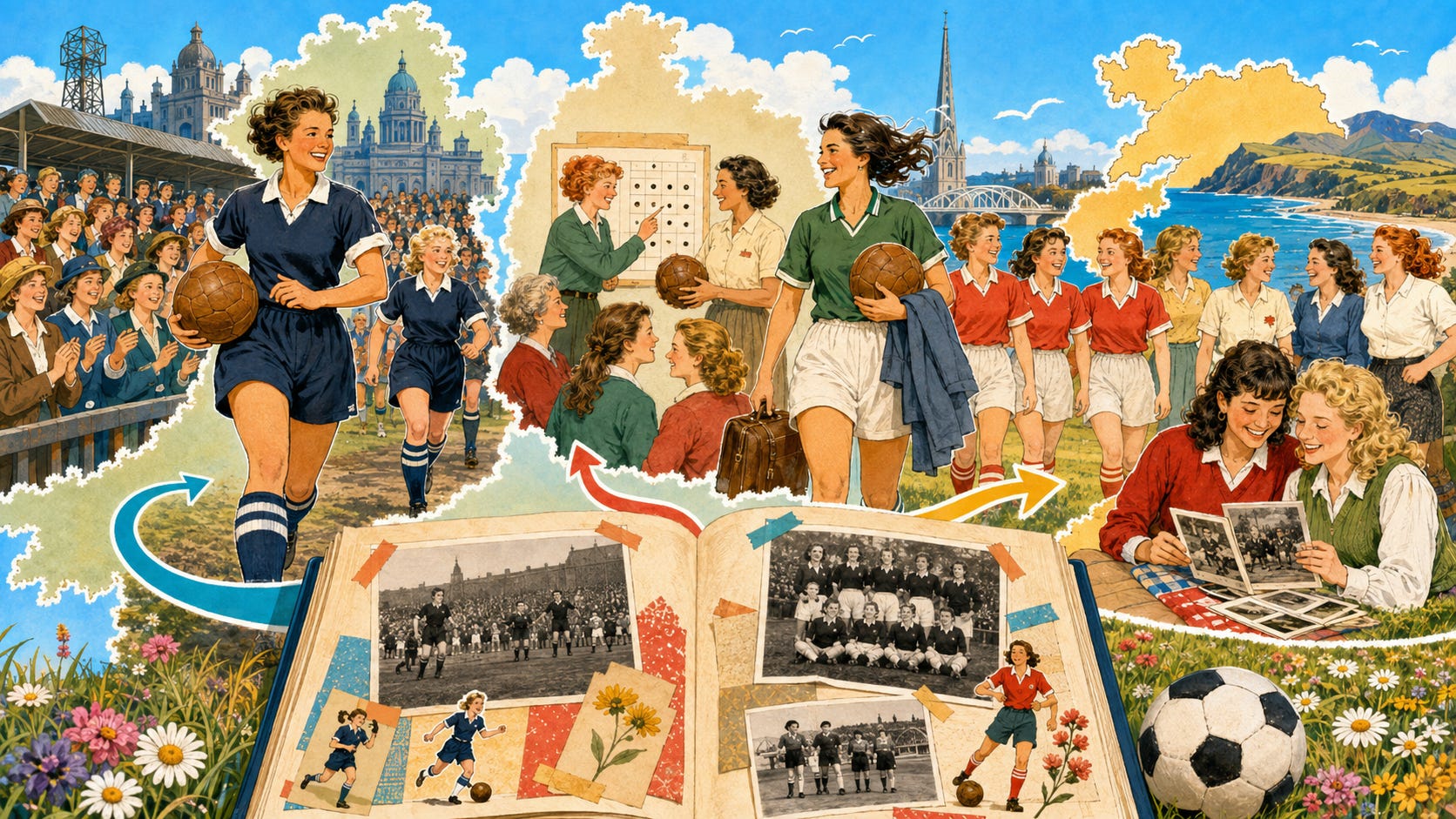
Women’s football grew in pockets: players formed teams, teams created small competitions, and those competitions slowly began to join the dots across each country.
They are stories of resilience, determination, and playing without permission.
Today, I’m looking at three more of those beginnings: Big Molly Seaton drawing crowds in Northern Ireland, an Irish Benfica, and the Prestatyn Ladies’ scrapbook.Subscribe
Northern Ireland
A British Ladies FC tour in 1895 introduced football to the women in Northern Ireland but the first swell of interest came during the First World War.
A pseudo international game between Ireland and England at Windsor Park attracted 10,000 spectators. The game was a testimonial in honour of Mrs Walter Scott – not even afforded her own first name in the record books – who set up a Ladies Football Guild in 1916.
It was the appeal of Irish woman “Big Molly Seaton” who brought wider attention to the game in Northern Ireland when her Scottish side Rutherglen toured the area in the late 1920s. Molly was a superstar of her time and always drew a crowd.
Although the Irish Football Association didn’t ban women from playing football like other FAs, there was no support for the game making it hard to organise.
During the 1970s, the Northern Ireland Ladies Football Association formed and became affiliated to the English Women’s Football Association (WFA).
By summer 1973, Northern Ireland had an eight-team league. Seven of these teams were:
- Mayfair (Portadown)
- Albion (Ballymena)
- Minerva
- Berkshire
- Comber
- Millisle
- Glenavon
The eighth team wasn’t listed in the IFA source I found.
Mayfair were a clothing factory team from Portadown. Seven members of Northern Ireland’s first international squad came from the team. The other six clubs above were all represented too.
This original league was reorganised only a few years later.
In November 1976, representatives came together to form the Northern Ireland Women’s Football Association. They met at the Post Office Youth Club in Belfast to hold their first meeting.
They established league rules, the constitution, how they would recruit clubs and players, and elected their first chair – Mary McVeigh.
They began a summer league in 1977, and 18 teams were divided into three divisions of six. Unfortunately, the names of the teams seem – so far – to be lost in the sands of time. Three early teams who may well have been amongst the 18 were: Blue Birds, Dynamos, and Buzby Babes.

Republic of Ireland
It was Molly Seaton and the Rutherglen team who also brought women’s football to the Republic of Ireland. But it wasn’t until much later that it began to catch on.
One of the oldest clubs in the Republic of Ireland was Benfica of Waterford. Formed in 1965, they were apparently part of a women’s league of 22 teams, but I’ve found limited information on this so far.
A Dublin Ladies Football League was established in 1971 and one of their first champions (possibly the first) was Jeyes.
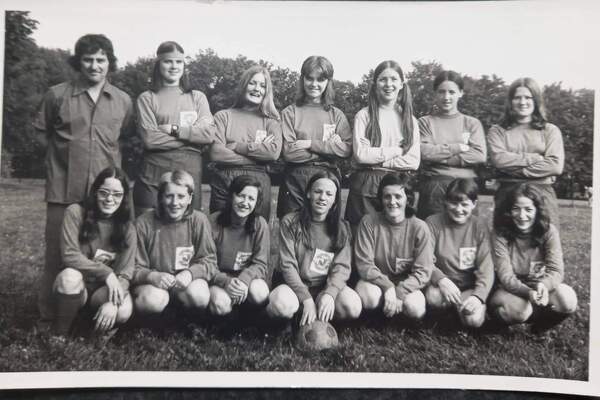
Jeyes of Figlas
Jeyes was a works team formed in the Jeyes factory in Finglas. Having won the league, they toured France making a strong connection with French side Reims. In 1973, Reims made the return trip to Ireland.
It was during that tour that Irish legend Anne O’Brien was spotted by Reims boss Pierre Geoffroy. He was so impressed he offered her a contract to join the semi-professional Reims. She was only 17 at the time and had to wait until she turned 18 before she could move away to France.
The Dublin Ladies Football League built momentum around the game in Ireland – although I’m yet to find a good record of anything beyond the success of Jeyes.
Whatever its story, it helped spark the Ladies Football Association of Ireland in 1973. Independent of Football Association Ireland (FAI), it began to organise the regional and workplace leagues that were forming.
At the same time, the Ladies League of Ireland was formed. This was a national league, organised by FAI.
Twelve teams were invited to the first league:
- Dundalk
- Finn Harps
- Cork Celtic
- Limerick
- Sligo Rovers
- Benfica (Waterford)
- Evergreen (Kilkenny)
- Avengers, formerly Jeyes (Dublin)
- Cahir Park (Tipperary)
- Beejays (Galway)
- Happy Wanderers (Galway)
- Wasps (Galway)
Later Elms United – also of Galway – joined.
By 1979, only seven teams competed and the league was discontinued in the 1980s. It was relaunched in 1987 but only survived for three more seasons.
Thanks for reading She Can Kick It! This post is public so feel free to share it.
Editor’s note: for anything and everything about the Republic of Ireland, I defer to my great friend Bobby Power of www.GoWildMagazine.com I have asked him if he can add any background information and I look forward to sharing that with Clare.
Wales
Much like other parts of the British Isles, the First World War provided the backdrop for women’s munitions teams. The first known league in Wales formed in 1917-18. The South Wales Women’s Munitions League had three silver cups as prizes.
Newport Ladies won the league in its first season and the National Shell Factory Swansea won the Munitions Cup in 1918.
There were also some games in North Wales during the wartime period, but it would be decades before a sustained league structure emerged in the region.
In 1969, Prestatyn Ladies was formed by two sisters : Mia and Eleri Griffith. Wonderfully, they kept scrapbooks of their games, which have been preserved.
They give a long list of their opponents, who included:
- Dyserth Ladies
- Llanrwst Ladies
- Rhyl High School Girls
- Mostyn Ladies
- Deeside Firebelles
- Connah’s Quay Firebelles
- Modo Marvels
- South Caernarvon Creameries
- Point of Ayr Ladies
- Halkyn Ladies
- Wrexham Ladies
As a side note, the current Wrexham Women’s team played in the Champions League qualifiers this season, although unfortunately didn’t make it through. But they’ve come a long way because, in the Griffiths’ scrapbook, Wrexham were once beaten 25-0 by Prestatyn.
Despite the number of teams around in North Wales, there doesn’t seem to have been anything resembling a formalised league. So Prestatyn joined the Merseyside and Wirral League in the north west of England.
In South Wales, a 10-club league formed in 1972. It mainly consisted of factory and workplace teams, including Johnson Rangers of Port Talbot and Maurice Cohen, who were sponsored by a local lingerie manufacturer.
A couple of years later, around eight clubs were reportedly affiliated to a short-lived “Welsh League”, but little else is known.
By 1976, some of the leading South Wales teams began moving into England’s Western League.
These included:
- Cardiff West End
- Newport Nightingales
- Llanedeyrn, who later became Cardiff City Ladies

Regional leagues continued to come and go and it wasn’t until 1992 that a more sustained league – the South Wales Women’s and Girls’ League formed. It still exists today and may be the start of a more lasting structure in South Wales.
Since North Wales teams often crossed the border into England to join their leagues, it wasn’t until 2003 that a modern North Wales Women’s Football League was formed.
And it was only in 2009 that Wales had its first national league. The Welsh Premier Women’s League is now known as the Adran Premier league.
This is part of a series on the formation of early leagues in women’s football.
Here’s part 1click and 2 click:
Editor’s note : thanks to Clare for the background information on Jeyes
Share