Next Step Will Be Europe
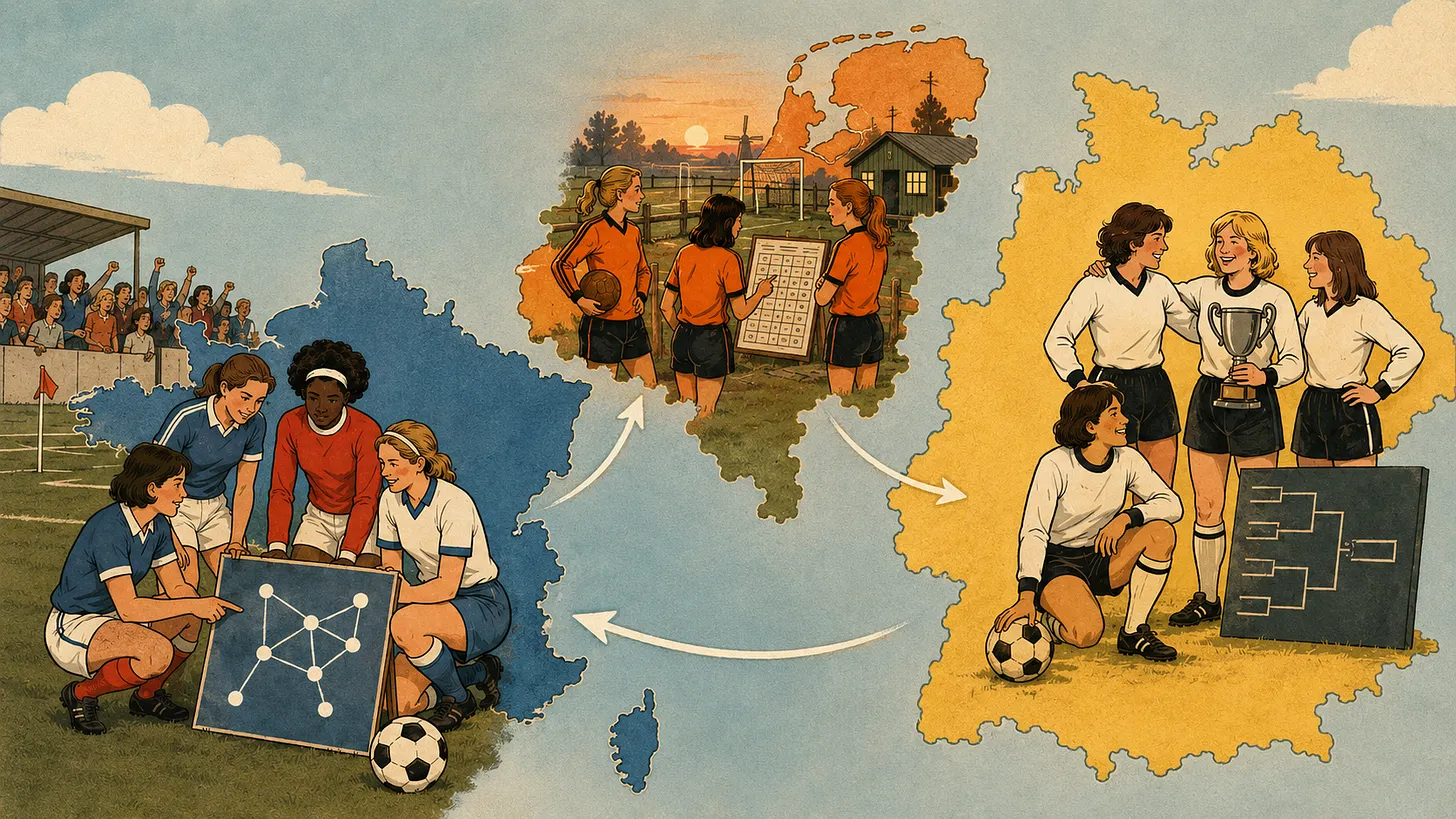
How organised women’s football began across Europe
Part 1 of an ongoing series of how competitions and leagues began to form. This article looks at Germany, the Netherlands and France.
Many of you have been enjoying Clare McEwen’s history of the women’s game in the UK. In true Evita style she now moves on to Europe
Women’s football grew in pockets: players formed teams, teams created small competitions, and those competitions slowly began to join the dots across each country.
Most were built without football federation backing; most were built in the face of bans and prejudice.
They are stories of resilience, determination, and playing without permission.
Today I’m looking at three of those beginnings: an unofficial cup in Germany, an independent league in the Netherlands, and regional competitions that helped revive women’s football in France.
Germany
The Deutscher Fussball-Bund (DFB) – the German Football Association – banned women from using their pitches much later than England. It wasn’t until 1955 that the ban came in – over 30 years after the FA in England halted the game.
It was a much shorter ban – lifted in 1970 – but recognition came with restrictions: women could only play 70-minute games, the ball had to be smaller, and they had a six-month winter break. Women waited until 1993 before their game became aligned with the men’s game.
Prior to the lifting of the ban, though, teams began to organise their own competitions.
Formed in 1969, TuS Wörrstadt are part of the fabric of German football history. Before any official tournament began, their manager Philipp Scheidt organised an early national competition between regional champions.
The intention was to call it the German Cup but the DFB refused to recognise it. When Scheidt threatened to go to the press with the story, a compromise was reached. The cup became the Gold Cup.
TuS Wörrstadt beat Bayern Munich 3-1 in the first final.
A year later, in 1974, the DFB organised the first German women’s football championship. A tournament rather than a league, the event included 16 teams from across West Germany.
- Werder Bremen (from Bremen)
- Buxtehuder SV (Hamburg)
- Sparta Göttingen (Lower Saxony)
- Wiker SV (Schleswig-Holstein)
- Bonner SC (Middle Rhine)
- Prussia Krefeld (Lower Rhine)
- DJK Eintracht Erle (Westphalia)
- SC 07 Bad Neuenahr (Rhineland)
- SV Bubach/Calmesweiler (Saarland)
- TuS Wörrstadt (Southwest)
- FC Germania Untergrombach (Baden)
- FC Bayern Munich (Munich)
- NSG Oberst Schiel (Hesse)
- SpVgg Wiehre (South Baden)
- TSV Grötzingen (Württemberg)
- Tennis Borussia Berlin (Berlin)
The teams were divided into four groups and the winners progressed to the semi-finals.
TuS Wörrstadt then sealed their place in history by becoming Germany’s first women’s champions.

Netherlands
Sparta Rotterdam tried to form a team to play an English team in 1896. In an all too familiar story, the KNVB – the Dutch football association – banned it.
There was another failed attempt to organise the match in 1924 – the ban remained in place.
In April 1955, the Dutch Ladies Soccer Association (NDVB – Nederlandse Dames Voetbalbond) was formed.
After a proposal by women’s club Herbido, the founding meeting was held in Utrecht. The chairperson and board members were all female and they discussed the organisation of a competition and set the rules on playing time and ball size.
Fourteen teams joined the first national women’s league in the Netherlands and they were initially split into two districts of seven teams.
They played from August to October and from March to May using a size four ball and playing two 30-minute halves.
All women had to wear football boots and undergo a medical exam to make sure they were healthy.
The teams were:
District A
- DCO (Haarlem)
- Full Speed (IJmuiden)
- Minerva (Dordrecht)
- EHDVV (The Hague)
- Union (Vlaardingen)
- Zeemeeuwen (Velsen)
- Zilvermeeuwen (Zaandam)
District B
- Apoldro (Apeldoorn)
- Herbido (Utrecht)
- Holviams (Amersfoort)
- Rievelo (Utrecht)
- Rood Wit Blauw (Nijmegen)
- SVA (Almelo)
- Voetballerina’s (Hilversum)
Unfortunately, before the season began, four clubs – Apoldro, Rood-Wit-Blauw, Voetballerina’s, and Zilvermeeuwen – withdrew. VVV (Rotterdam) was added as a replacement and the league was reorganised into a single 11-team group.
It was then that the KNVB stepped in and prohibited clubs from allowing women to use their pitches.
The KNVB back-tracked a little when they realised the women weren’t interested in becoming part of their organisation. It allowed them to access pitches, provided their matches didn’t affect the recognised men’s games.
Since pitches were busy all weekend, the women effectively had to play at 7am or 7pm.
Despite this, the league ran from August 1955 to spring 1956. Utrecht’s Herbido won the league having dominated it with 12 wins and 2 draws and zero losses.
No wonder they were keen to start it.
The competition lasted only one season but its legacy shaped the later development of women’s football in the Netherlands.

France
France’s first FFF-backed national women’s championship began in 1974 but the foundations were laid beforehand through a patchwork of unofficial regional competitions.
In the mid-1960s, Schwindratzheim in the Alsace region was one of the first women’s clubs to form. In the 1969-70 season, a competition involving nine teams began in the Bas-Rhin area. The Alsace region already had 18 teams across different areas.
FC Schwindratzheim won the first final of the competition, beating Notre Dame de Strasbourg. One of their players – Marilou Duringer – became a key figure in the development of women’s football in France. Two years later, there were 25 clubs playing in the Alsatian leagues.
Not too far away in Reims, journalist Pierre Geoffroy advertised for players for a women’s team. The team was intended for an exhibition match at a fair rather than a grand gesture to build something more. But Geoffroy, surprised by the interest, ended up forming Reims – he’s now regarded as the father of modern women’s football in France.
Soon afterwards, Reims played Schwindratzheim in front of 6,000 people, as the opening game before a men’s fixture. The Reims players wanted to continue playing and went on to build an impressive legacy. They travelled around the world playing in Italy, Czechoslovakia, Mexico, Canada, Haiti, Indonesia and more.
Their visibility and the growing momentum in the region helped lead to the launch of the Challenge du Coq Sportif in Champagne-Ardenne. Thirteen teams took part and Reims came away with the trophy.
Football spread across France and pockets of teams began to emerge in other regions. By the end of the 1970-71 season, France had 2,170 registered female players.
Four years after formally recognising women’s football, France’s Football Federation (FFF) launched its national championship in 1974. By then, there were reportedly 260 clubs playing regional football.
Sixteen teams competed in four groups, with a round-robin stage followed by knockout rounds.
The first full national league for women in France began in 1992-93, a year after England did the same.
Three countries, three different beginnings. All built from a simple love of the game and a will to play.
This is part of a series on the formation of early leagues in women’s football. Which country should I investigate next?
Enjoyed this article? You can support my research and writing with a virtual coffee (tea in my case) on Ko-fi. Every contribution helps me keep uncovering and sharing the stories of women’s football.
Share