Origins of Women’s Football – England and Scotland

How organised women’s football began across Europe: England and Scotland
This is the second part of Clare McEwen’s in depth research on the Origins of Women’s Football in Europe. The first part can be found here
Women’s football grew in pockets: players formed teams, teams created small competitions, and those competitions slowly began to join the dots across each country.
Most were built without football federation backing; most were built in the face of bans and prejudice.
They are stories of resilience, determination, and playing without permission.
Today, I’m looking at two of those beginnings: regional leagues in England that helped lead to the formation of the Women’s Football Association, and Scottish teams organising independently despite continued resistance from their own football authority.

England
Although England’s women’s football history goes back to Victorian times, and the game experienced a strong period of growth during and after the First World War, regional leagues didn’t really begin to form until after England’s men won the World Cup.
When the Jules Rimet trophy was lifted by Bobby Moore in 1966, women’s interest in playing football soared. More women discovered the beautiful game and wanted to be a part of it.
Teams and leagues began to form, despite the ban still being in place. Perhaps they didn’t even know it existed.
Patricia Gregory, who was inspired to form a team around this time, wrote to her local paper looking for other players. It wasn’t until she formed White Ribbon and began looking for pitches that she discovered women were actually banned from using FA-affiliated pitches.
She was undeterred.
Several regional leagues were formed in the late 1960s, including the Warwickshire Ladies Football League (1967), the Midland Ladies Football League (1968), and the South East of England League (1968).
The Midland Ladies Football League included the following teams:
- Nuneaton Wanderers
- British Rail of Wigston
- Emgals
- Nuneaton Rangers
- Rockmill
- Leicester City Supporters
- Bedworth Babes
- Bantams
- Bedworth Flamingoes
You’ve got to love some of those names – how cool are they?
Around this time, a group of young female supporters formed Birmingham City Ladies FC, although it doesn’t look like they joined the league at this point.
A few teams broke away to join the newly formed Heart of England Ladies’ Football League, which began in 1970. The league was later restructured and became known as the West Midland Regional League.
Birmingham City Ladies FC joined the new league. Throughout the next two decades, the Blues won various league and cup titles. In 2011, they became one of the founding members of the Women’s Super League and finished as runners-up twice.
They were relegated in 2022 but now, nearly 60 years after being formed, Birmingham City are back in the WSL for the 2026-27 season.

Scotland
Around the same time, more women’s teams and leagues began to form in Scotland – despite strong resistance from the Scottish FA.
Many of Scotland’s early women’s teams grew out of workplaces, factories and local communities. For example, Cambuslang Hooverettes were linked to the Hoover factory, while Glasgow Gay Ladies / Glasgow Gay Eleven took their name from Gay’s biscuit factory, and were later renamed Westthorn United Ladies FC.
Alongside them were teams including Stewarton Thistle, Fife Dynamites, Tayside Toppers, and Holyrood Bumbees, helping create a growing network of women’s football across Scotland..
The first formal modern women’s league in Scotland seems to have been set up in Glasgow in 1968, but little is known about it. From the limited accounts I’ve found, Stewarton Thistle, Westthorn United, and Cambuslang Hooverettes all seem to have been a part of the league but, at this point, I can’t find any further information.
The Scottish Women’s Football Association (SWFA) was established in 1972, shortly after UEFA had voted to bring unofficial organisations under national football association control. There were 31 votes in favour of this move, and only one against: Scotland.
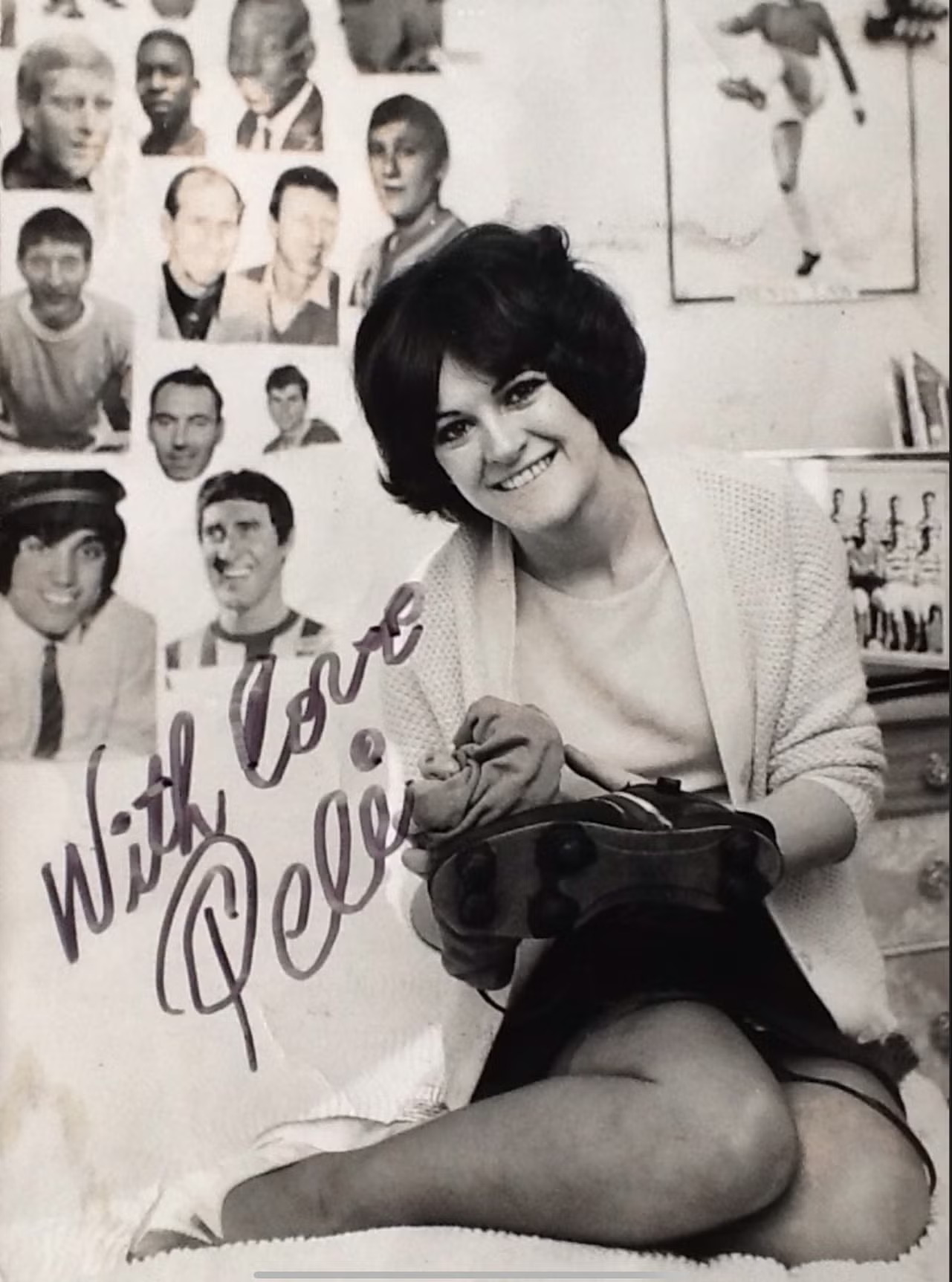
ELSIE COOK – with her treasured Pele photograph and autograph
Stewarton Thistle’s manager Elsie Cook became the first secretary of the SWFA and helped steer women’s football in Scotland forward.
Cook had been inspired to do everything in her power to build women’s football in Scotland after seeing talented young baller Susan Ferries play.
Ferries made her debut for Stewarton Thistle in 1961 against Holyrood Bumbees. The game was played to raise money for the famine in Ethiopia and ended in a 7-1 victory for Stewarton.
Ferries scored all seven goals. The boots she scored the goals with were second-hand from a shop in Kilmarnock called Cheapside Bargains. They lasted her 12 years and are now on display at the Scottish Football Association Museum.
Elsie Cook was also on the pitch for Stewarton that day and saw something very special in young Ferries. Cook later said:
“After that day, that was me on a mission to prove to men and to women that ladies could play football, and it was because of Susan Ferries.”
Editor’s Note: Elsie has also be inducted into the Scottish Football Hall of Fame and written a book about Stewarton, Pele, Kilmarnock FC and much more
This is part of a series on the formation of early leagues in women’s football. Which country should I investigate next?
If you enjoyed this article, you can support my research and writing with a virtual tea on Ko-fi.
Remember – Part 1 is here