Black Pioneers 4
Celebrating Black Pioneers of Women’s Football, part 4.
Brenda Sempare, Charmaine Hooper, Portia Modise
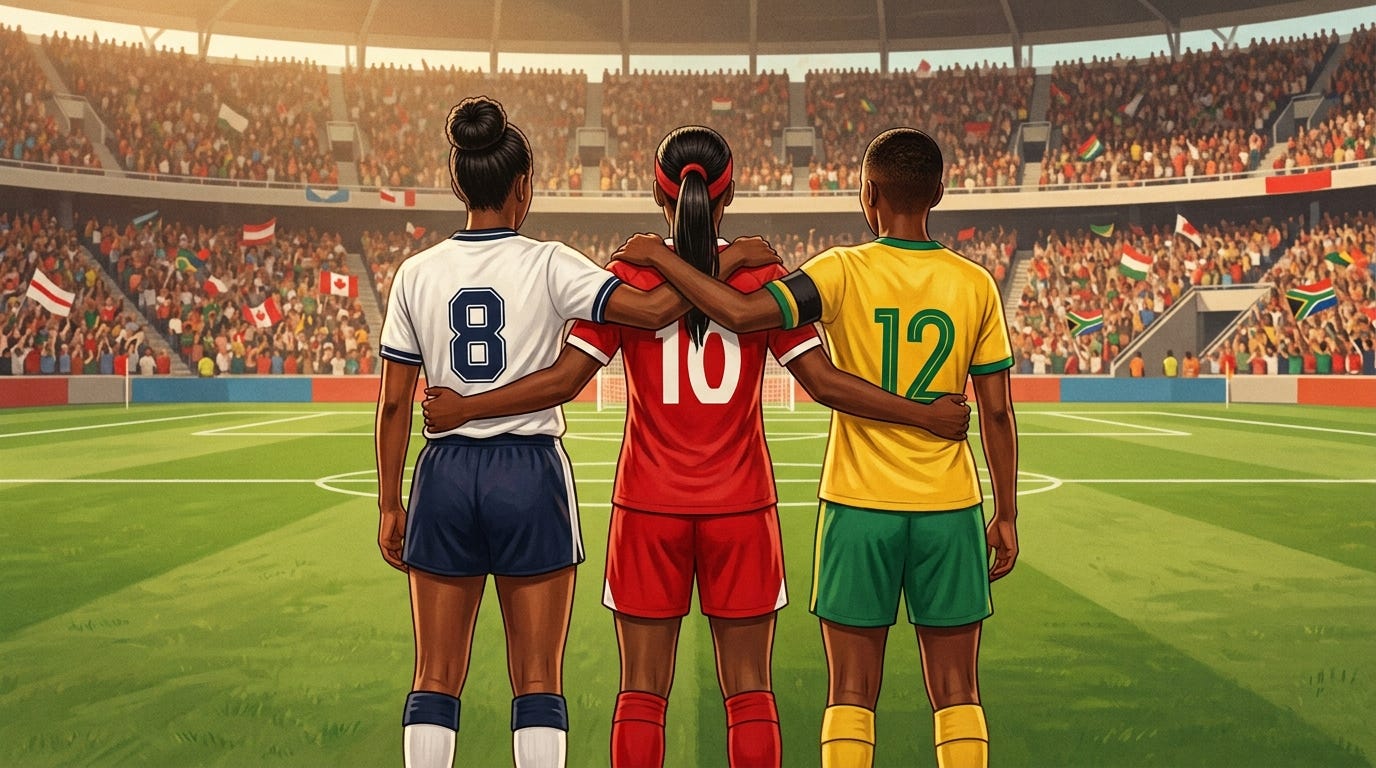
Part four of Clare McEwen’s mini series celebrating the Black women of women’s football history for Black History Month.
Brenda Sempare
Brenda Sempare was described by Hope Powell as, “outrageously skilled…for me, she was one of the best players ever to pull on an England shirt.”
She scored crucial goals for club and country and was one of the finest players of her generation.
Sadly, I can’t find anything about Brenda’s early life and how she got into football.
In fact, details about her life and career are pretty hard to find: born in 1961, played her senior football for Friends of Fulham and Bromley/Croydon, and made her England debut in 1983.
But Brenda has left a trail of footballing moments, footballing stories, to document her time as a player.
Sempare made her debut for England in 1983 against the Republic of Ireland. The next year, she was part of the England squad who reached the first UEFA Women’s European Championship final – losing to Sweden on penalties.
In 1985 Brenda scored one of the most important goals of her career at the Mundialito in Italy. England had reached the ‘little World Cup’ final against hosts Italy.
Having lost to Denmark, drawn with Italy, and beaten the USA in the group stage, they made the final. It was played in front of 10,000 people and the second half was shown on Italian TV.
Brenda scored a crucial goal in the 3-2 win over the hosts (Marieanne Spacey scored the other two). England lifted the Mundialito trophy to become unofficial World Champions.
She Can Kick It is a reader-supported publication. To receive new posts and support my work, consider becoming a free or paid subscriber.
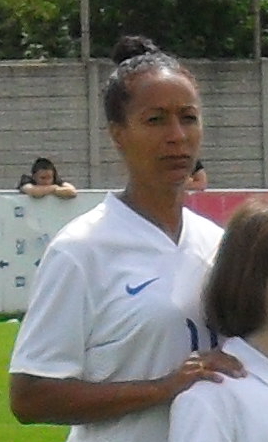
By Sevcoteehee – Own work, CC BY-SA 4.0, https://commons.wikimedia.org/w/index.php?curid=42213410
1985 was an all-round good year for Brenda Sempare, as she was influential for both club and country. Her performance for Friends of Fulham in the 1985 FA Cup final is the stuff of legend. “The Sempare Final” as it became known, gives you an idea of just how good she was – she ran the show that day and Fulham claimed their first FA Cup in a 2-0 win over Doncaster Belles.
She again represented England at the 1987 UEFA Euros, helping them reach the semi-final. She was working as a postwoman at the time.
In 1992, she joined the newly formed Bromley Borough – later to become Croydon – started by Hope Powell and Sue Law. As a new team, they had to start at the bottom of the pyramid. It was clearly the wrong league for them and they cruised through a few levels of the pyramid, destroying the teams in their wake. The team made it all the way to the semi-final of the FA Cup that season, only halted by the treble-winning Arsenal.
Brenda played in England’s first Fifa World Cup in Sweden in 1995. She played all four games, including wins over Canada and Nigeria. She played her final game for her country in their quarter-final loss to Germany, having racked up 55 appearances and five goals.
Her international career may have ended but Brenda Sempare wasn’t quite done.
In 1995-96, Croydon won the league and FA Cup double. They were unbeaten in the league that season. But the title came down to Brenda Sempare scoring their winning goal against Arsenal. They won the title on goal difference over Doncaster Belles.
The week before she’d also scored in the penalty shootout to win the FA Cup final over Liverpool.
Brenda Sempare retired not long after and was inducted into the English Football Hall of Fame in 2010.

Charmaine Hooper
Canadian player Charmaine Hooper was born in Georgetown, Guyana in 1968. Her father was a diplomat so they moved around. She began playing football with her brother when she was eight. By 18, she was representing Canada.
Born in Guyana’s capital, Charmaine’s first experience with football came when the family moved to Zambia. She began playing with her brother and his friends at school.
The family moved to Ottawa, Canada in the late 1970s and it was here Charmaine joined her first girls’ team: Nepean Hotspurs.
She played college football/soccer for the NC State Wolfpack team (North Carolina State University), setting various records along the way – most goals in a season (26), most consecutive games with a goal (7), and tied for most goals in a game (4). Plus wider accolades like Atlantic Coast Conference (ACC) highest goalscorer and All-ACC for three consecutive years. She was also twice named an first-team NCAA All-American.
Credit: Canadian Press
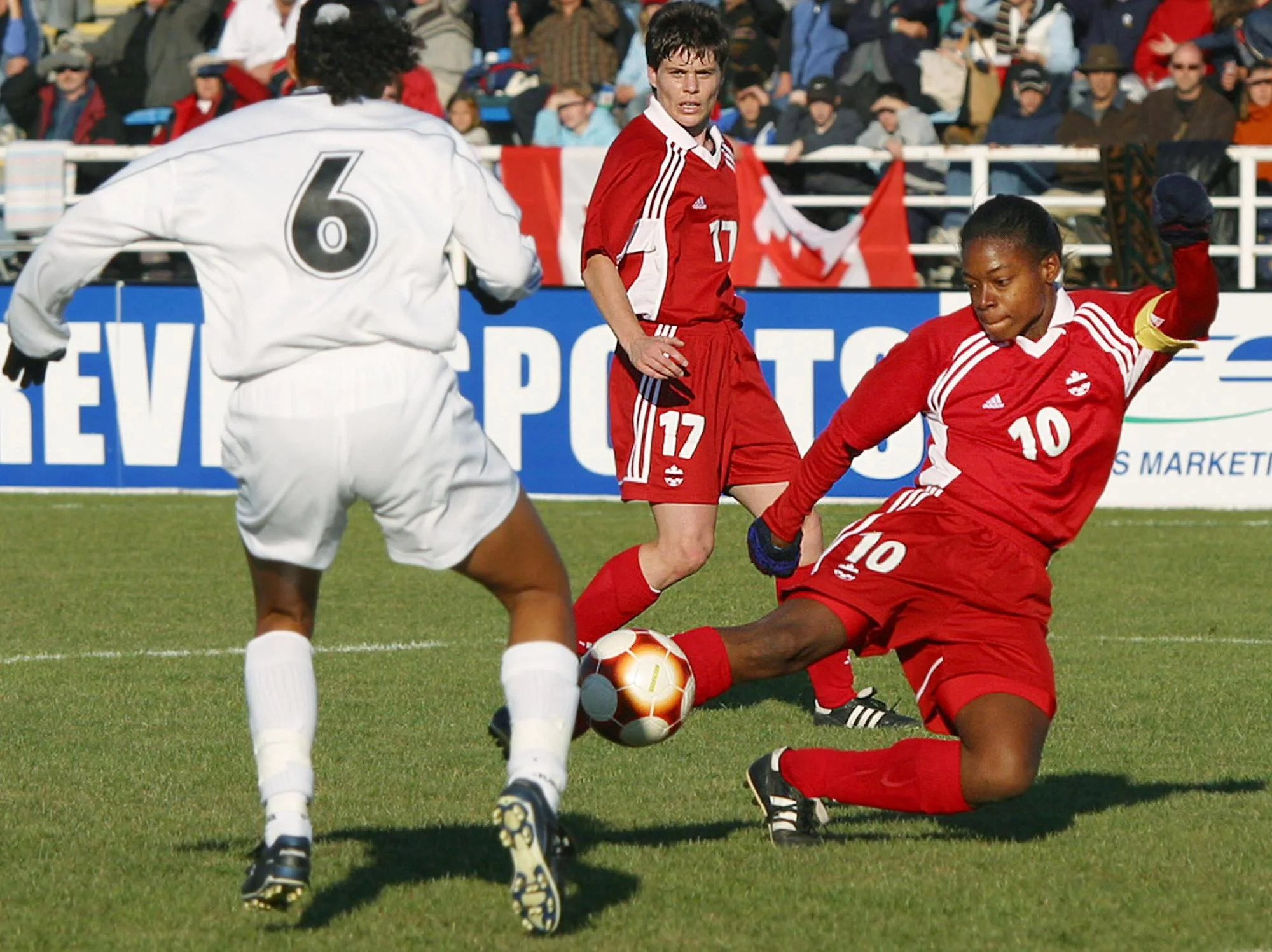
Creator: Rob Kruyt
The team were also successful during this period, winning an ACC championship and reaching the NCAA final – their best ever finish – plus semi- and quarter-finals.
Charmaine Hooper was part of the very first Canadian women’s national team in 1986. A team that the Canadian Soccer Association wasn’t really giving much backing to.
Their coach Neil Turnbull was told that if they lost both games in their debut two-game series against the USA, they wouldn’t get funding to carry on the programme. Hardly supportive. They lost the first 2-0 but won the second 2-1 – saving the programme. Charmaine Hooper, aged just 18, assisted Canada’s first ever international goal in that second game. Geri Donnelly scored both and remembers their first goal came “on a great pass by Charmaine Hooper”.
In February 1999, Charmaine scored both goals for a Fifa World All-star team that inflicted the USA’s first home defeat in over 40 matches.
Hooper played in three Fifa World Cups: 1995, 1999, and 2003. At the first two, she was recognised by the Fifa Technical Study Group as one of Canada’s outstanding players. After the 2003 event, they described Charmaine as an “inspirational leader”. And it was this World Cup that she captained the team to their best ever finish, fourth place.
By then she had moved from forward to defence but at 35 years old, she headed Canada’s winning goal against China in the 2003 World Cup quarter-final. She played all 540 minutes of Canada’s six games and was named in the Team of the Tournament.
Known as a hugely physical player, Hooper was also tough off the pitch. In 2006, while still captain, she refused to play two friendlies. She and two other players alleged that the Canada coach had pressured them to break their club contracts and join the Vancouver Whitecaps.
Ultimately, they were suspended and lost their funding.
Charmaine Hooper played 129 games for Canada and scored 71 goals.
As well as a stellar international career, Charmaine had a globe-trotting club career.
Due to a lack of league in the US (or indeed Canada), players often moved abroad. Hooper played in Norway, Italy, and Japan before moving to the United States. During her time in Japan, she played as a professional for Prima Ham FC Kunoichi. She reportedly earned $100,000 per season while playing in Japan. She returned nearer home after four seasons, having won everything she could out there.
When the Women’s United Soccer Association (WUSA) professional league began in 2001, Charmaine signed with Atlanta Beat. She played all three seasons of the WUSA, totalling 34 goals in 59 games.
She later played for the Chicago Cobras, the New Jersey Wildcats and Fort Worth FC before retiring in 2008.
Charmaine Hooper was inducted into the Canada Soccer Hall of Fame and Canada’s Sports Hall of Fame in 2012.

Portia Modise
South African footballer Portia Modise was the first African to score 100 international goals. She got into her first team by borrowing someone else’s birth certificate.
Born in White City, Soweto in 1983, Portia Modise began playing football on the streets aged around seven.
From an early age she’d told her mum she wasn’t a girl and didn’t want to play with girl’s toys. But she did very much want to play football – a boys’ game at the time.
She joined Soweto Rangers under-10s, pretending to be a boy, but ran into trouble when registration required a birth certificate.
Not willing to give her opportunity up, she asked the boy next door if she could borrow his – he agreed.
She later joined the women’s section of Jomo Cosmos in Johannesburg.
Modise was once scouted for the School of Excellence alongside South Africa men’s legend Steven Pienaar. Unfortunately, she couldn’t join because they only accepted boys. They suggested she find a women’s team.
She joined Soweto Ladies in 1996 – aged around 12/13 – after the coach had been impressed with her playing style.
Her mum wasn’t particularly happy with her pretending to be a boy and playing football but when she saw Portia play for Soweto Ladies, she began to understand.
In the year 2000, aged 16, Portia Modise was called up to the senior South Africa international team. She was the under-19s captain at the time.
She played in all of her country’s games in the 2000 Women’s African Football Championship and scored her first goal against Zimbabwe. She also played in South Africa’s final defeat to Nigeria.
Modise continued to play for Soweto Ladies for many years and in the 2001-02 season scored 51 goals in the league. In 2003, she was invited to trial with Arsenal Ladies.
Manager Vic Akers was impressed with her but the deal couldn’t get done. Reports vary but somehow the move fell through over money.
In 2005, Portia was one of two Africans nominated for Fifa World Player of the Year – the other was one of Part 3’s stars, Perpetua Nkwocha. Although Germany’s Birgit Prinz won.
By this point Portia was captaining her country and in 2006 she was named Player of the Championship at the African Women’s Championship. She was also voted in the top three of the CAF Women’s Footballer of the Year and was in the Fifa World All-Stars game before the 2007 World Cup draw.
Modise quit international football in 2008 because of head coach Augustine Makalakalane. He was later sacked after accusations of sexual harassment and homophobia. But by then, Portia Modise had lost four of her prime international playing years.
In 2012, she was able to safely come back to the international team that went to South Africa’s first ever Olympics. In their first game against Sweden at the City of Coventry Stadium, Portia scored a ridiculous goal from the centre circle – although the team lost 4-1. A goalless draw against Japan at the Millennium Stadium in Cardiff was their only point of the group stage.
She went into the Olympics with 71 goals in 92 caps. By May 2014, she had reached 98 goals, four coming from a 13-0 qualifying win over Comoros. In October, she scored number 99 and 100 against Algeria. She became the first African footballer – woman or man – to reach 100 international goals. She had already passed 100 caps.
In April 2015, she scored her last international goal in a match against Botswana. She retired the following month having scored 101 goals in 124 games.
It’s worth noting that she reached these incredible numbers having played all but two seasons of her club football in South Africa’s amateur leagues. The two professional seasons were with Fortuna Hjørring in Denmark.
Not bad for a girl who had to borrow a birth certificate to start her journey.
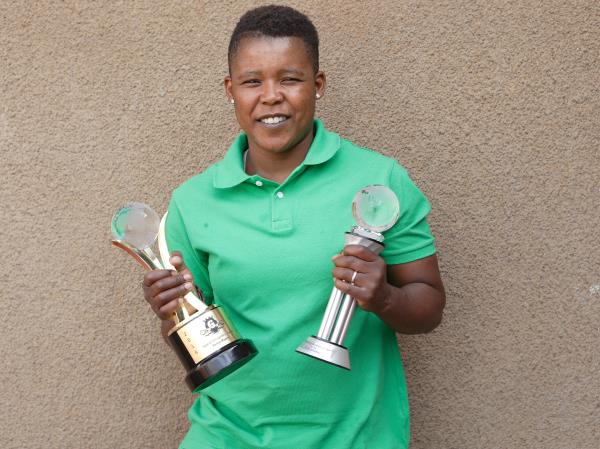
Credit: Portia Modise Foundation
Further reading:
https://www.protagonistsoccer.com/coverage/2025/2/17/charmaine-hooper-usl-legend-soccer-canada-canadian-nationalteam
https://nationalfootballmuseum.com/halloffame/brenda-sempare

Part 1 featuring Emma Clarke, Kerry Davis and Hope Powell can be found here:
✍️ Written version of part 1
🎙️Audio version of part 1 read by me (free to all)
Part 2 featuring Beverly Ranger, Mary Phillip, and Rachel Yankey can be found here:
✍️ Written version of part 2
🎙️Audio version of part 2 (read by me – Paid subs)
Part 3 featuring Sissi, Briana Scurry, and Perpetua Nkwocha can be found here:
✍️ Written version of part 3
🎙️Audio version of part 3 (read by me – Paid subs)
Subscribe to She Can Kick It
By Clare McEwen · Launched 4 years ago
Women’s football – the past, present, and future of the game – written by author and journalist, Clare McEwen (who is still raging about being denied football as a kid but now channels it positively – mostly – here).
Share