Women’s World Cups
Women’s World Cups – an alternative World Cup History
Despite my best efforts to avoid the Trumpfest, I realise that it is being played on the other side of the pond. My first World Cup was 1966 and I can still remember the 16 (only!) teams and, of course, all eleven players in the win over West Germany. Then Mexico 70 and who can forget Spain and Italy. By the turn of the millennium, politics had overshadowed the on-field action with S.Korea/Japan, South Africa, Qatar and Russia all spotlighted for non-sporting reasons. Then came the debacle that is 2026. Everyone deserves better – the fans with 4 am kick offs and obscene pricing, the players being herded across half a continent, the officials, some of whom have been made most unwelcome or even refused entry, yes, everyone! We are not a week in and Trump’s Berlin has offered little on the field to match the dramas off it. Embarrassing.
To that backdrop, it’s good to get some balance and Ms Women’s Football, Clare McEwen has forwarded a most interesting article about the Women’s World Cups in Disneyland, Canada and Mexico. Thanks so much, Clare.
Women’s World Cups
The FIFA Men’s World Cup – as I think it should be renamed – is GO.
And Substack is rammed with brilliant writing on the subject.
I have loved football all my life, and World Cup memories punctuate my formative years.
But you know by now that I write about women’s football.
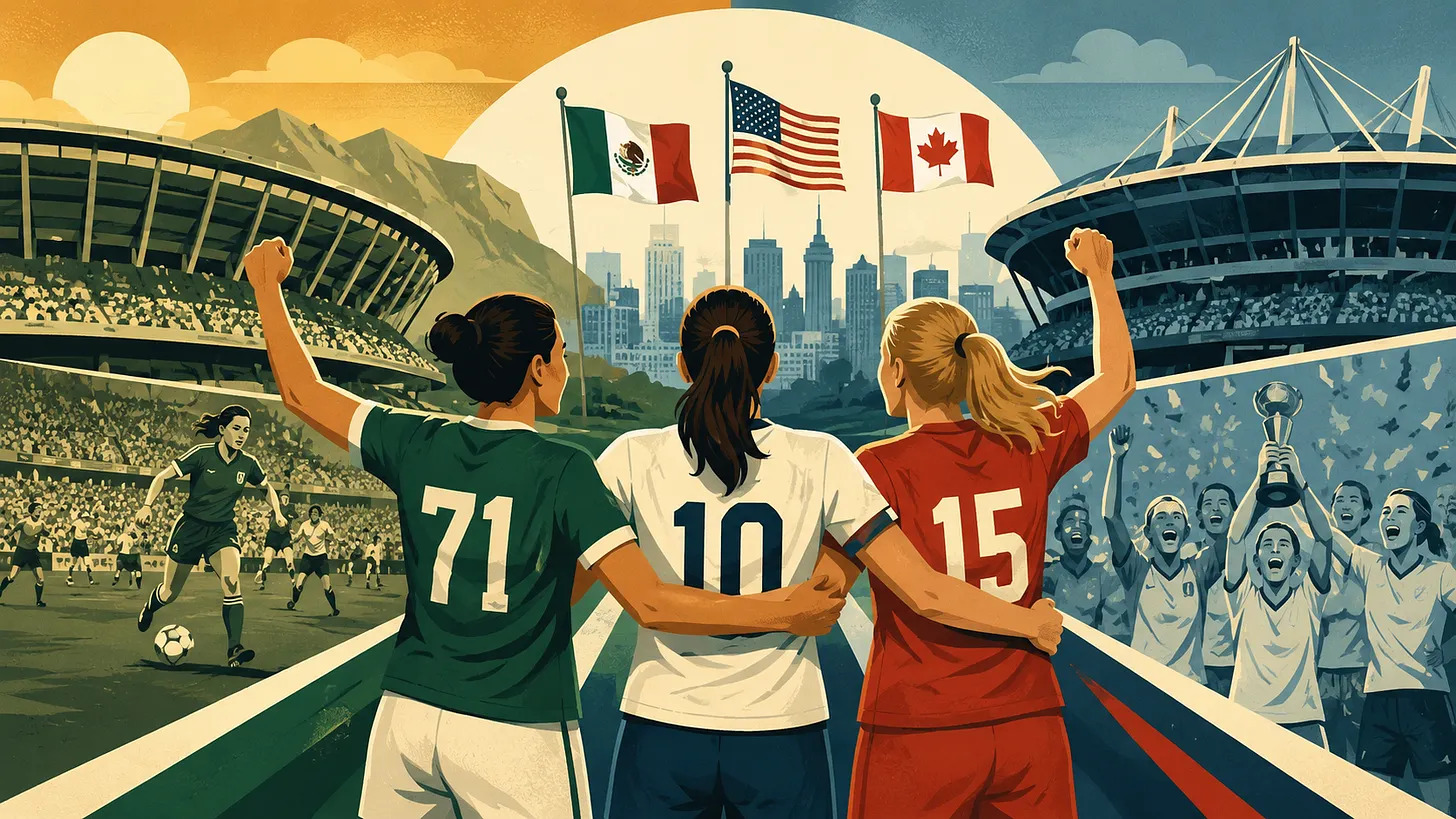
As it happens, the three 2026 Fifa World Cup host nations have hosted a women’s World Cup too.

Seeing the beautiful Azteca stadium host the opening game of the men’s World Cup reminded me of the images from Mexico ‘71.
The year before, it had hosted the 1970 Fifa men’s World Cup – the one where Pelé and Brazil cemented themselves as footballing icons.
In 1971, it was the turn of the women.
This one had nothing to do with Fifa – and it was still enormous.
The Mexican football federation, along with the Italian-based Federation of Independent European Female Football (FIEFF), organised a massive tournament.
The Azteca and Guadalajara stadiums were used – just as they had been in the men’s World Cup then, and now.
Attendances were enormous, reaching a peak of around 110,000 in the final between Mexico and Denmark,
Beyond Mexico, though, it was invisible – this was the lost generation of female stars.
Susanne Augustesen
Susanne Augustesen scored a hat-trick in the final – have you heard of her?
She was 15 years old.
Have you heard of Pelé ?
Yeah, he scored in a World Cup aged 17, and we still talk about it.
Denmark
Denmark won the final and lifted the pre-Fifa World Cup for the second year in a row.
The Danish FA still don’t recognise it because it was before the team was “official”.
Inglaterra
England had to play as the British Independents because they weren’t officially recognised by the English FA.
Many of the players were schoolkids as they could go to Mexico for a few weeks in the summer whereas the older players worked and couldn’t get time off.
They were adored as “Inglaterra” in Mexico but when they returned home they were banned from playing.
Read more on the 1971 Mexico World Cup.

Build the dream
FIFA first staged their Women’s World Cup in 1991.
The USA won.
In 1999, they hosted a watershed Fifa Women’s World Cup.
Despite the US Women’s National Team (USWNT) being told by Fifa that there wouldn’t be enough interest to fill the largest (mostly American football) stadiums in the country, over 90,000 people watched the final in the Rose Bowl in Pasadena.
How?
The USWNT and the US organising committee believed this could be massive.
Fifa wouldn’t support them booking the biggest venues so the committee took on the risk themselves.
The players themselves went out into the communities, visited schools, and raised awareness that the World Cup was coming to town.
The event attracted huge sponsors for the first time, including Coca-Cola, McDonald’s, and Fujifilm.
And stadiums across the land were filled.

The tournament had expanded to 16 teams for the first time, and 15 of the 32 matches were played as double-headers.
Tickets were mostly marketed at dads and their daughters and the tournament slogan was “This is my game. This is my future. Watch me play.”
A total of nearly 1.2 million people went to stadiums to watch. The total attendance remained a record until the expanded 2015 World Cup.
In the United States, all 32 matches were televised – 26 live and six on delay. Games were broadcast across the world and, for the first time, reached a global audience.
The US didn’t disappoint their home fans and played a thrilling finale against China.
The game remained 0-0 at full-time. It remained 0-0 after extra time.
The penalty shootout gave the world the most iconic women’s football photo of all time: Brandi Chastain on her knees, double fist-pumping, shirt in her hand, and her black sports bra on show for the world to see.
It was liberating, powerful, and symbolic.
It changed the football landscape for women.

The green, green artificial turf of home
Canada 2015 also proved something of a watershed – for both positive and negative reasons.
Fifa, in its wisdom, decided it would be fine for the Women’s World Cup to be played on artificial turf.
The players didn’t agree.
They were concerned about the additional injury risks from the surface. And also the gender discrimination.
Fifa had never held a men’s World Cup to be played on an artificial surface, after all.
A group of players filed a lawsuit against Fifa.
And the issue sparked debate across the world.
But there was no Plan B, so the games went ahead as planned, on artificial pitches.
Pitch surfaces during the tournament reached blistering temperatures and some players described it as like walking on hot coals.
Not ideal.
The Lionesses
On the plus side – at least if you are a Lionesses fan – Canada 2015 was the start of something special.
Although they started their campaign with a loss to France, wins against Mexico and Colombia secured qualification for the knockout stages.
Having been a goal down to Norway in the Round of 16, England did it the hard way and came back to win 2-1, in Ottawa.
Back home, the BBC showed all 52 matches live across its platforms.
Although it was not the full coverage we expect from a Women’s World Cup just a decade later, the level of coverage at the time, was unprecedented.
The level of excitement around the Lionesses went up a notch.
Drawn against hosts Canada, England played their quarter-final in front of 54,000 people in Vancouver.
England were two goals up within 15 minutes. Canadian legend Christine Sinclair pulled one back before half-time, but England saw the game out to reach the semi-finals.
The Lionesses were in great company in the last four – perhaps showing signs of their growing pedigree.
Japan were reigning champions.
Germany were two-time winners.
USA were two-time winners.
The tournament had only been played six times (Norway were the other winners).

England were drawn against Japan. They were level at 1-1 at half-time, but a cruel stoppage-time own goal saw the reigning champions through.
And Lionesses fans experienced what Three Lions fans already knew – England World Cup heartbreak.
It was the first time I’d had my heart broken watching the Lionesses (obvs it was all too familiar from the men’s team). To lose in that manner, a moment of extreme bad luck just before the promise of extra time – devastating.
Somehow, the team bounced back for the third-place play-off.
And unlike the men’s team, they defeated Germany. A Fara Williams penalty in extra time was the only goal of the game.
The bronze medal was celebrated like it was the trophy, both in Canada and at home.
Because this was the dawn of a new era – and in those moments, we felt it.
If you liked this post and want to support my work, check out my new merch shop.
Thanks for reading, Clare.
If you want to read more check Clare’s Substack